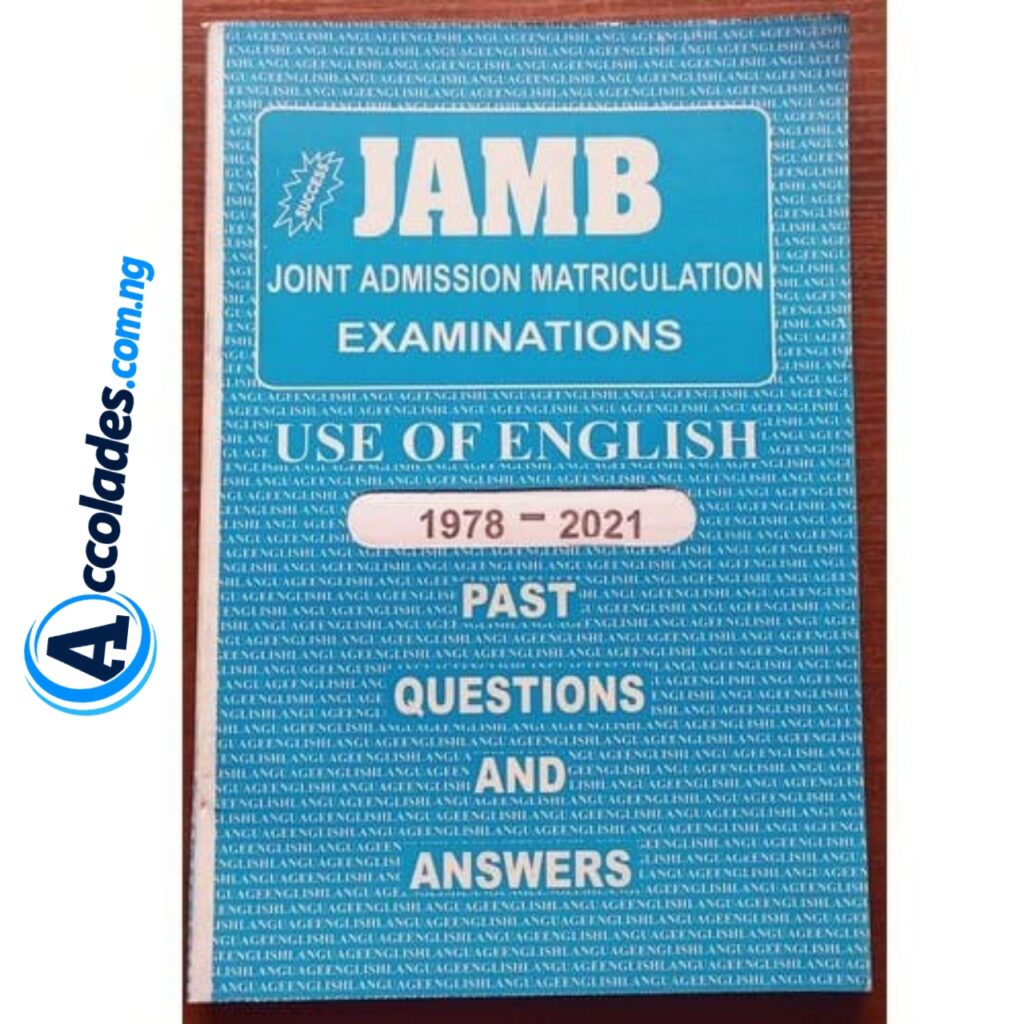
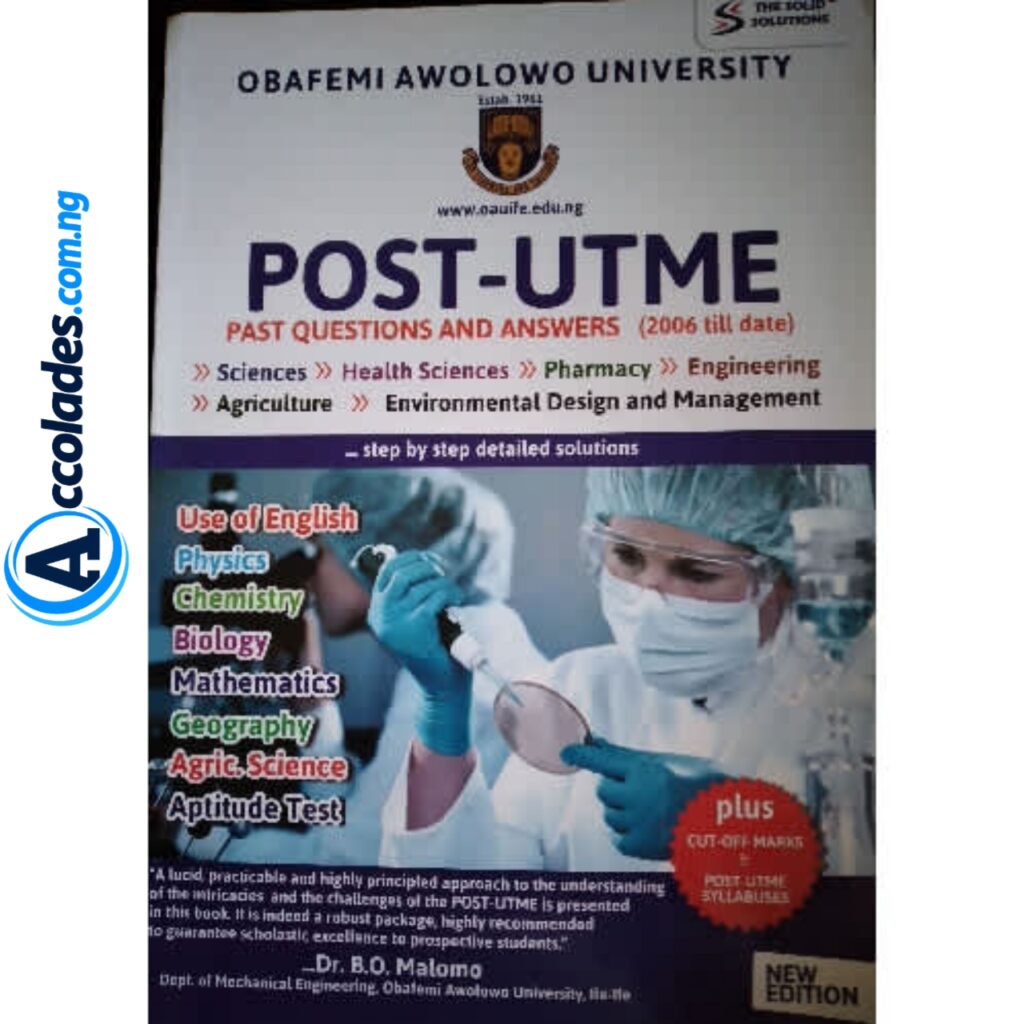
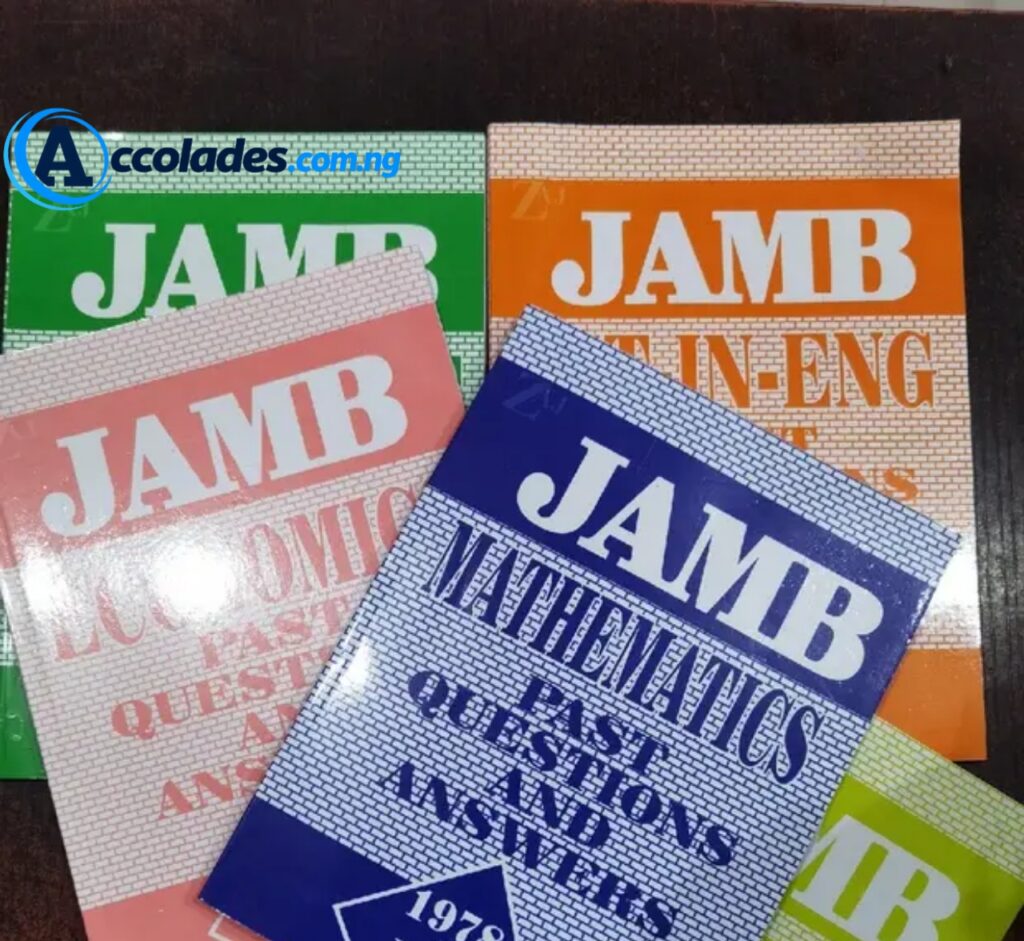
Ask any student who scored high in UTME Chemistry what they did differently, and you will hear the same answer. They stopped treating the textbook as the whole battle and started treating past questions as the real syllabus. If you are hunting for a chemistry jamb past questions and answers pdf, this blog post shows you what to look for, how to study with it, and the mistakes that quietly cost candidates marks every year.
Why Chemistry Past Questions Matter More Than You Think
JAMB does not invent Chemistry questions from thin air. The board works from a fixed syllabus, and examiners keep returning to the same ideas, just dressed differently. A question on mole calculations in 2015 may come back in 2022 with new numbers. A question on identifying a gas from a test result keeps reappearing with a different gas.
Once you have worked through 8 to 10 years of questions, you begin to notice this. You stop being surprised in the exam hall, and that calm is worth a lot when the clock is running.
What a Good Chemistry JAMB Past Questions PDF Should Contain
Not every PDF circulating online is worth your data. Before you download anything, check that it has these:
- Several years of questions, ideally from the early 2000s up to the most recent exam.
- Correct answers that are clearly marked. Wrong answer keys are more common than people admit.
- Worked explanations for calculation questions, so you learn the method and not just the letter.
- Clean formatting. Chemical formulas and subscripts that turn into garbled text will confuse you more than help you.
If the file fails any of these tests, skip it.
The Topics That Keep Showing Up
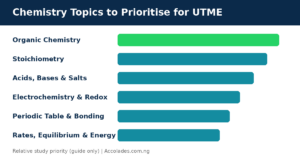
Chemistry carries 40 questions in your UTME paper, and they are not spread evenly. Going through past papers, these areas tend to take a big share of the marks:
| Area | What examiners like to ask |
|---|---|
| Organic Chemistry | Naming compounds, functional groups, isomers, and the reactions of alkanes, alkenes and alkanols |
| Stoichiometry | Mole concept, empirical formulas, percentage composition, volumetric analysis |
| Acids, Bases and Salts | pH, indicators, titration, types of salts, hydrolysis |
| Electrochemistry and Redox | Oxidation numbers, electrolysis products, electrochemical series |
| Periodic Table and Bonding | Trends across periods, electronic configuration, types of bonds |
| Rates, Equilibrium and Energy | Le Chatelier’s principle, factors affecting reaction rate, enthalpy changes |
If your time is short, start with organic chemistry and stoichiometry. They are the two areas where steady practice converts into marks fastest.
A Study Method That Actually Works
Many candidates download a PDF, read through the answers, and feel productive. That is passive learning, and it fades quickly. Try this instead.
Step 1: Attempt cold, with a timer
Pick one year and do all 40 questions in about 20 to 25 minutes without peeping at the answers. UTME gives you roughly two hours for four subjects, so speed has to be trained.
Step 2: Mark honestly, then sort your mistakes
Do not just count your score. For every wrong answer, write down why you missed it: you did not know the concept, you made a calculation slip, or you misread the question. You will quickly see which kind of error is hurting you most.
Step 3: Keep a small “error notebook”
Write the question topic, the correct idea, and one line explaining it in your own words. Review it every weekend. Candidates who do this rarely repeat the same mistake twice.
Step 4: Revisit the same year after two weeks
If you can now answer questions you previously missed, the learning has stuck. If not, go back to the topic and fix it before moving on.
Common Traps in UTME Chemistry
- Rushing calculations. Many options are deliberately close in value. A small arithmetic slip lands you on a tempting wrong answer.
- Memorising without understanding. Examiners often twist a familiar question slightly. If you only memorised the letter, you are stuck.
- Ignoring practical-based questions. Tests for gases, ions and apparatus handling appear regularly, and they are easy marks if you have revised them.
- Skipping units. Mixing grams with kilograms or cm³ with dm³ is a classic way to lose a mark you had already earned.
Pair Chemistry With Your Other Subjects
Chemistry rarely stands alone. Most science candidates also write Physics and Biology, and a smart revision timetable rotates between them so no subject goes cold. You can build your Physics practice with our guide on Physics JAMB past questions and answers PDF, and sharpen your calculation speed with JAMB past questions for Mathematics. If you want a wider archive across all subjects, see our collection of JAMB past questions and answers from 1983 to 2023.
Where to Confirm the Official Details
Always cross-check your syllabus with the source. The official JAMB website publishes the current syllabus and exam guidelines, so you know exactly which topics are in scope. For clear, free explanations of tough concepts like equilibrium or organic reaction mechanisms, LibreTexts Chemistry is a reliable place to read further.
A Realistic Weekly Plan
You do not need to study chemistry for six hours a day. A steadier routine works better:
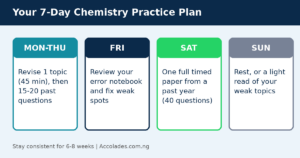
- Monday to Thursday: one topic revision session (45 minutes) followed by 15 to 20 past questions on that topic.
- Friday: review your error notebook.
- Saturday: one full 40-question timed paper from a past year.
- Sunday: rest, or a light read of weak topics.
Stick to this for six to eight weeks and the improvement is usually obvious.
Frequently Asked Questions
Is a chemistry JAMB past questions PDF enough to pass?
It is the strongest single tool you can use, but pair it with your syllabus and a good textbook so you understand why answers are correct.
How many years of past questions should I practise?
Aim for at least ten years. More is better, because patterns become easier to spot as the sample grows.
Can I use the PDF on my phone?
Yes. Most candidates study on their phones. Just make sure the PDF is clear enough to read formulas without zooming constantly.
Final Word
A good score in Chemistry does not come from luck or last-minute cramming. It comes from repeated, honest practice with real questions and a willingness to learn from every mistake. Start today, stay consistent, and let the past papers teach you what the examiners expect.
Ready to begin? Get your copy of the Chemistry past questions with answers directly on WhatsApp.
Written by Accolade, for Accolades.com.ng