If your exam question says “discuss the purpose of National Benchmark Test”, or you are a student planning to apply to a South African university, you have probably wondered what this test is really for. Is it an entrance exam? Can it stop you from getting admission? Do you need to cram for it? Let’s clear all of that up, one point at a time.
In short, the National Benchmark Test (NBT) exists to show how ready a new student is for the academic demands of university, and to help institutions place that student in the right programme with the right support. It is not a pass-or-fail exam, and that single fact changes how you should think about it.
What Is the National Benchmark Test?
The National Benchmark Tests Project began in 2005. It is run by the Centre for Educational Testing for Access and Placement (CETAP), which is based at the University of Cape Town, on behalf of Universities South Africa. Most public universities in the country use it in some form.
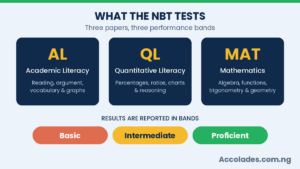
The NBT has three parts: Academic Literacy (AL), Quantitative Literacy (QL) and Mathematics (MAT). Everyone applying through the system writes AL and QL together in one sitting, while MAT is a separate paper that is mostly required for programmes with a strong maths component, such as engineering, sciences, commerce and health sciences. Each sitting runs for about three hours, so it is better to arrive rested.
The Main Purpose of the National Benchmark Test
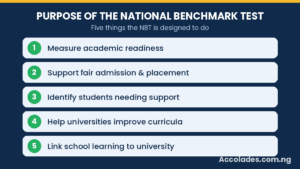
When you discuss the purpose of the National Benchmark Test properly, you will find it serves several goals at the same time. Here are the ones that matter most.
1. To measure real academic readiness
A Grade 12 certificate tells a university what you studied and what marks you scored. It does not always show whether you can read a dense journal article, interpret a graph quickly or handle algebra at first-year speed. The NBT fills that gap by testing the skills you will need from your first lecture, not the content you memorised for school exams.
2. To support fair admission and placement decisions
Schools across a country differ widely in resources and teaching quality. Two students with identical final marks may arrive at university with very different preparation. Many institutions therefore combine your school results with your NBT performance, which gives admissions officers a second, standardised measure. For borderline applicants, a strong NBT result can make a real difference.
3. To identify students who need extra support
Results are reported in performance bands: Basic, Intermediate and Proficient. A student in the Basic band is not being punished. The university simply learns early that this student could benefit from tutorials, a mentorship programme or an extended degree structure that spreads the first year over two years. This is one of the most humane uses of the test, and many students do better because of it.
4. To help universities plan their curriculum
Because thousands of students write the same test, the results reveal patterns. If many applicants struggle with data interpretation or reading comprehension, lecturers can redesign first-year courses to address exactly those weak points. The NBT therefore benefits institutions as well as individual candidates.
5. To connect what schools teach with what universities expect
The test also gives policymakers useful information about the distance between the school system and higher education. That feedback loop is rarely mentioned in short answers, yet it is a strong point to include if you need to write an essay or give a detailed explanation.
Looking to study abroad or move up the academic ladder and not sure where to start? You can browse more guides on our admission and exam preparation guides to see what else may apply to you.
What Does the NBT Actually Test?
Academic Literacy checks whether you can read carefully, follow an argument, draw conclusions and understand how a text is built. It also looks at vocabulary and your ability to work with information in tables and graphs.
Quantitative Literacy is about using numbers in everyday and academic situations: percentages, ratios, trends, charts and logical reasoning. You do not need advanced maths here, but you do need comfort with figures.
Mathematics is based on the school maths curriculum and is the most content-heavy of the three. Expect algebra, functions, trigonometry, geometry and problem-solving.
Common Myths About the National Benchmark Test
- “If I score low, I will be rejected.” Not necessarily. Each university decides how much weight to give the NBT, and a low score is often used to guide support rather than to turn you away.
- “It is just another school exam.” It is not. It measures skills and reasoning, so last-minute memorisation helps very little.
- “Everyone needs all three papers.” Requirements depend on the university and the course, so always check your chosen institution first.
How to Prepare Without Stress
The best preparation is steady and practical. Practise reading long passages and summarising them in your own words. Work through sample questions under timed conditions so the three-hour length does not shock you. Revise core maths topics if you are writing MAT, and get comfortable reading graphs without panic. The official National Benchmark Tests website publishes information on test content, registration and sample materials, so start there. You can also read what a leading institution says about admissions on the University of Cape Town website.
Also remember that registration deadlines are fixed and results are only valid for a limited time, so confirm dates early rather than late. If you are an international or Nigerian applicant, extra paperwork can slow things down, which is one more reason to start planning months ahead.
Why the NBT Is Good for You, Not Against You
It is easy to see any test as an obstacle. A better way to look at the NBT is as an honest mirror. It shows you where you are strong and where you need to improve before the pressure of first year begins. Students who treat the result as a roadmap tend to settle into university faster, because they already know which skills to sharpen and which support services to use.
For employers and the wider education system, the benchmark also creates a common language of readiness. That is why the purpose of the National Benchmark Test goes beyond a single admission decision: it supports access, fairness and student success over the long run.
Quick Summary: The Purpose of the National Benchmark Test
- To assess the academic literacy, quantitative literacy and mathematics skills of prospective students.
- To give universities additional evidence for admission and placement.
- To identify students who may need extra academic support.
- To help institutions improve first-year curricula and teaching.
- To provide information on the gap between school and higher education.
Final Thoughts
So, if someone asks you to discuss the purpose of the National Benchmark Test, you can now answer with confidence: it is a tool for measuring readiness, guiding placement and improving student success, not a roadblock designed to keep you out. Prepare calmly, check each university’s requirements and treat your result as useful feedback. For more study guides, past question resources and admission tips, visit Accolades.com.ng regularly.
Note: Test formats, fees and requirements can change, so always confirm the latest details with the official NBT website and your chosen university before you register.