If you are applying to a South African university this year, you have probably typed some version of “nbt aql past papers” into Google at 11 pm. Same here, same panic, and honestly, same questions. What is a good NBT score? Where do I find past papers and memos? Which universities will actually ask for this test? Let me answer all of it in one place, so you can stop jumping between ten tabs.
First, a quick honest note about NBT “past papers”
The National Benchmark Tests (NBT) are written by the Centre for Higher Education Assessment (CHEA). The real test papers are not released after each sitting, so what students call “past papers” are really practice papers, sample tests and model papers built in the same format. That is fine. The format is what you need to master, and the more of it you see, the calmer you will be on test day.
NBT AQL past papers: what you are really practising
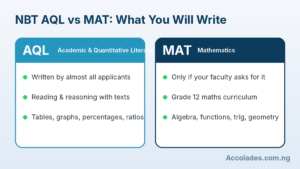
AQL stands for Academic and Quantitative Literacy. It is one paper, and it is written by almost everyone who sits the NBT. The academic literacy part checks how well you read, interpret and reason with texts, the way you will have to in first-year lectures. The quantitative literacy part tests how you handle numbers in everyday contexts: tables, graphs, percentages, ratios and word problems.
The trick with AQL is that you cannot “cram” it the night before. It is a skills test. Work through full timed practice papers, check each answer against a memo, and write down why you got a question wrong, not just what the right answer was.
NBT MAT past papers: for the maths-heavy programmes
MAT is the Mathematics test. You only write it if your chosen faculty asks for it, which usually means engineering, sciences, commerce, health sciences and similar programmes. It sits on the Grade 12 maths curriculum, and it also tests how well you reason through unfamiliar problems. Algebra, functions, trigonometry, geometry and calculus-style thinking all show up. Practise MAT papers with a pencil and no calculator habits you cannot repeat in the hall.
NBT practice questions: how to use them so they actually help
- Start untimed. Learn the question types first, then add the clock.
- Use a memo every single time. Practice without marking is just reading.
- Keep an error log. Three lines per mistake: what I did, what was right, what I will do next time.
- Do at least two full timed papers in the last two weeks before your test date.
NBT past papers and memos: why the memo matters more than the paper
Many students download a paper, struggle through it, and stop there. The memo is where the learning happens. A good memo shows you the working, so you can see how an examiner expects you to think. If you only check the final answer, you miss the method, and the method is what saves you when the real test throws a twist at you.
Advantage Learn NBT: is it worth it?
Advantage Learn is one of the better-known providers of NBT preparation in South Africa, offering online courses, practice tests and revision material. Many students use it as structured guidance. Whether you need it depends on your discipline. If you work well alone, free official resources plus good practice papers may be enough. If you need a study plan and someone to keep you on track, a structured course can help. Whatever you choose, compare prices and check what is included before paying.
What is a good NBT score?
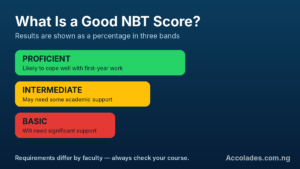
This is the question everyone asks, and the honest answer is: it depends on what you are applying for. NBT results are reported as a percentage and placed into performance bands, usually Basic, Intermediate and Proficient. As a rough guide, scoring in the Proficient band means you are likely to cope with first-year work without extra support, while Intermediate suggests you may need some academic support, and Basic suggests you will need significant support.
But each faculty sets its own rules. A competitive programme such as medicine or engineering will want a much stronger result than a general degree. Some universities combine your NBT with your matric (NSC) results into one admission score, while others use the NBT mainly to decide which support or extended programme suits you. Always check the exact requirement for your course on the university website. You can start with the official NBT website.
Universities that require the NBT
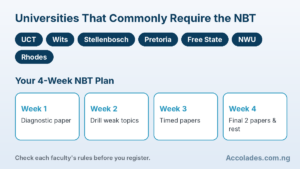
Several public universities in South Africa ask applicants to write the NBT, though the requirement usually depends on the faculty or programme rather than the whole university. Institutions that commonly use it include the University of Cape Town, the University of the Witwatersrand, Stellenbosch University, the University of Pretoria, the University of the Free State, North-West University, Rhodes University and others for selected degrees.
Requirements change from year to year, so confirm yours before you register. Missing a registration deadline is the easiest mistake to avoid and the most painful to fix. If you are also planning your wider study path, our exam preparation resources and the main Accolades.com.ng site have more guides that may help.
A simple four-week NBT plan
- Week 1: Take one diagnostic AQL (and MAT if needed) paper to find your weak spots.
- Week 2: Drill your weakest topics with practice questions and read every memo.
- Week 3: Do timed papers and review your error log.
- Week 4: Two final timed papers, then rest. Sleep beats last-minute cramming.
Seats and test dates fill up faster than most students expect, so do not leave your preparation until the final week. Start now while you still have time to improve.
Final thoughts
The NBT does not measure how clever you are. It measures how ready you are, and readiness can be trained. Find your practice papers, use the memos properly, know which universities need the test for your course, and give yourself enough time. Do that, and you will walk into the test hall far calmer than most.
Good luck, and write well.
Accolade