Every year, the University of the Witwatersrand (Wits) buys a huge range of goods and services, from cleaning and waste management to ICT equipment, printing, catering and maintenance. If you run a company that could supply any of these, Wits university tenders could be a serious source of business. The problem is that most suppliers do not know where the tenders are published, how the process works, or why so many bids get thrown out before anyone even looks at the price.
This guide explains to you in plain language, so you can stop guessing and start preparing.

What kinds of tenders does Wits publish?
Wits publishes tenders as RFPs (requests for proposals) and, for smaller needs, requests for quotations. Recent examples of the type of work advertised include:
- Supply and delivery of fast moving consumer goods (detergents, toiletries, batteries, disposables, crockery and more)
- Litho printing materials, including exam and test answer books
- Access control systems: supply, installation, support and maintenance
- Cleaning, hygiene, landscape maintenance, waste management and pest control
- Generator service and maintenance
- External audit services
- Graduation photography
- ICT panels of providers, such as networking equipment
The mix changes every year, so a tender that was open last season may not come back until the contract ends. That is why checking regularly matters.
Where to find open Wits tenders
There are two official places to watch, and you should check both.
1. The Wits tenders page. The university advises tenderers to check its official tenders page regularly for updates on active tenders. This is where the RFP documents are posted, along with tender numbers, briefing session details and contact emails.
2. PURCO SA. Wits also advertises many of its tenders through PURCO SA, the higher education procurement consortium. For some tenders you must register and buy or download the documents there, and questions are submitted through the PURCO SA website rather than directly to Wits staff.
Be careful about third-party sites that claim to list “all” Wits tenders. Some are outdated and still show tenders that closed years ago.
Can you just register as a Wits supplier?
This surprises a lot of people. According to the university’s supplier information page, Wits does not keep a separate database where companies can simply submit their details in the hope of being called. A department must first have a genuine business need, then motivate for a supplier to be loaded onto the Wits database after a procurement process has been followed. In other words, you get in by winning or being invited through a tender or quotation, not by emailing your company profile. You can read the university’s own wording on its supplier page.
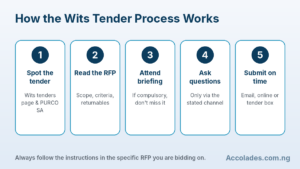
How the Wits tender process usually works
- Spot the tender. Find it on the Wits site or PURCO SA and download the full RFP document.
- Read everything. The scope of work, the mandatory criteria and the returnables schedule tell you exactly what is expected.
- Attend the briefing session if there is one. Some Wits tenders have a compulsory briefing, usually held at the Procurement Office in the Facilities and Services Building on West Campus, Braamfontein. If it is compulsory and you miss it, you are normally disqualified. Bring a valid driver’s licence or original ID, as it is needed to enter the premises.
- Send your questions the correct way. The instructions in each tender say whether to write to the tender administrator at Wits or to post on PURCO SA. Do not contact other university staff about a live tender.
- Submit before the deadline. Some tenders are submitted by email or online, others by sealed envelope in a tender box. The RFP tells you which.
Why good companies still lose Wits tenders
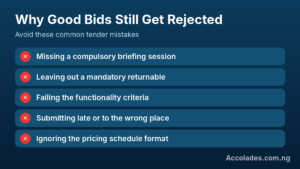
Most failed bids are not lost on price. They are lost on paperwork. Common mistakes include:
- Missing a compulsory briefing session
- Leaving out a mandatory returnable or leaving a schedule blank
- Failing the functionality or technical criteria, which are usually scored before price is even considered
- Submitting late or to the wrong place
- Pricing that does not follow the pricing schedule format
Typically, tender documents ask for things like company registration details, tax compliance, B-BBEE information and proof of experience, but the exact list is different for each tender. Always follow the returnables schedule in the specific RFP you are responding to, not a generic checklist.
A simple checklist before you bid
- Do I meet every mandatory criterion?
- Is there a compulsory briefing, and can I attend?
- When is the closing date and time, and how must I submit?
- Have I completed every schedule and signed where required?
- Has someone else read my submission before I send it?
Tender notices open and close quickly. If you only start looking after the closing date, you have already lost the opportunity. Set a reminder to check the Wits and PURCO SA pages every week, and keep your company documents ready and up to date so you can respond fast.
Final thoughts
Wits university tenders are open competitive processes, which means any qualified company can compete, but only the ones that read the documents carefully and submit complete bids will win. Watch the official Wits tenders page and PURCO SA, never miss a compulsory briefing, and treat the returnables schedule like a checklist you must tick completely.
For more practical guides, visit Accolades.com.ng, or browse our education resources.
Good luck with your bid.
Accolade